Question-based comparative legal analysis

Answer cooperative law questions across jurisdictions.

Co-op Atlas turns statutes and related legal source material into structured, reusable answers. It helps organizations compare how different jurisdictions handle recurring cooperative law questions.

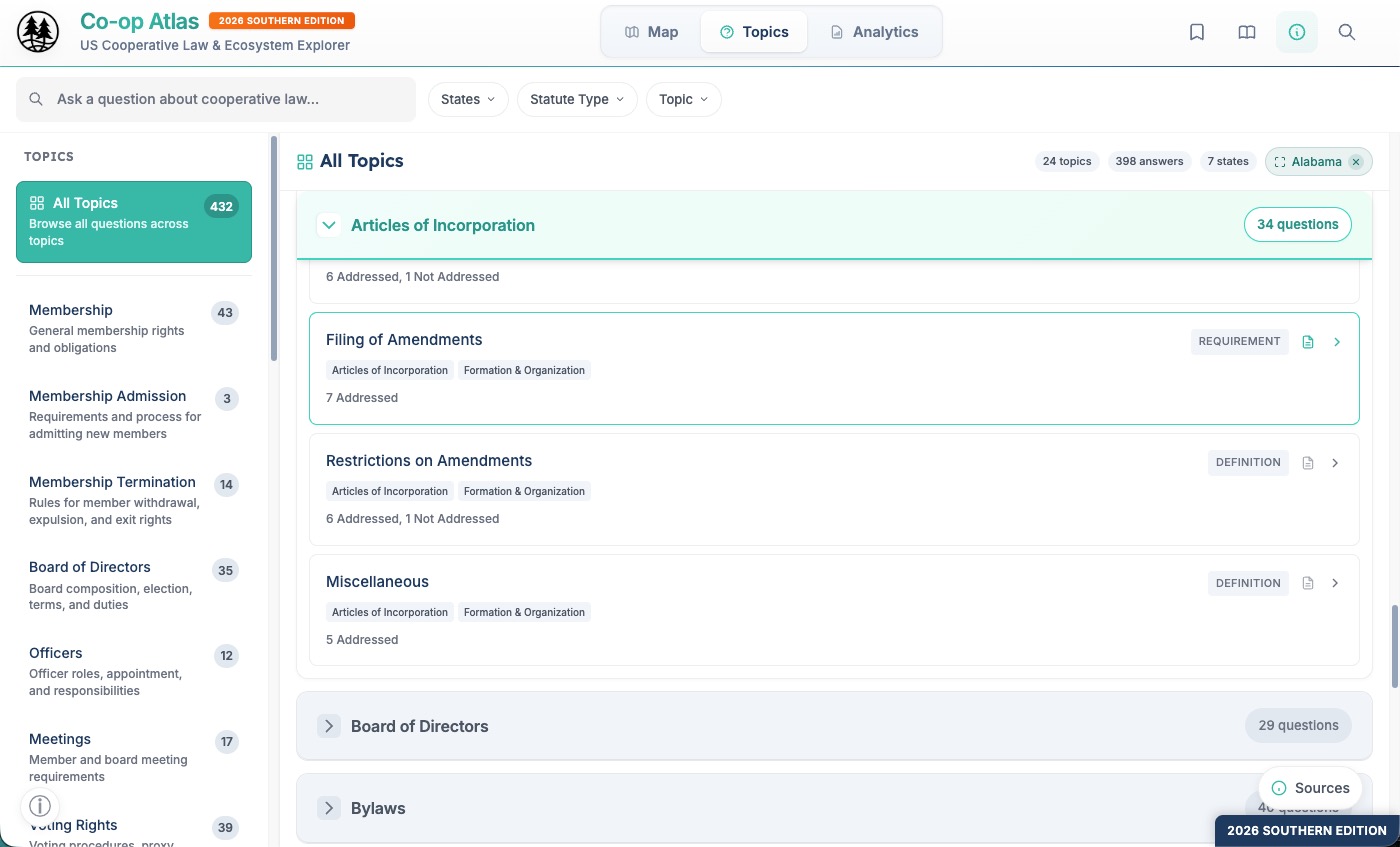
The initiative currently includes a Global Edition for international legal discovery and a U.S. Southern Edition that demonstrates question-based, citation-grounded comparative analysis in working briefs and outputs.

Question-based outputs
Structured answers, comparative summaries, and brief-style outputs built around recurring legal questions
Citation-grounded analysis
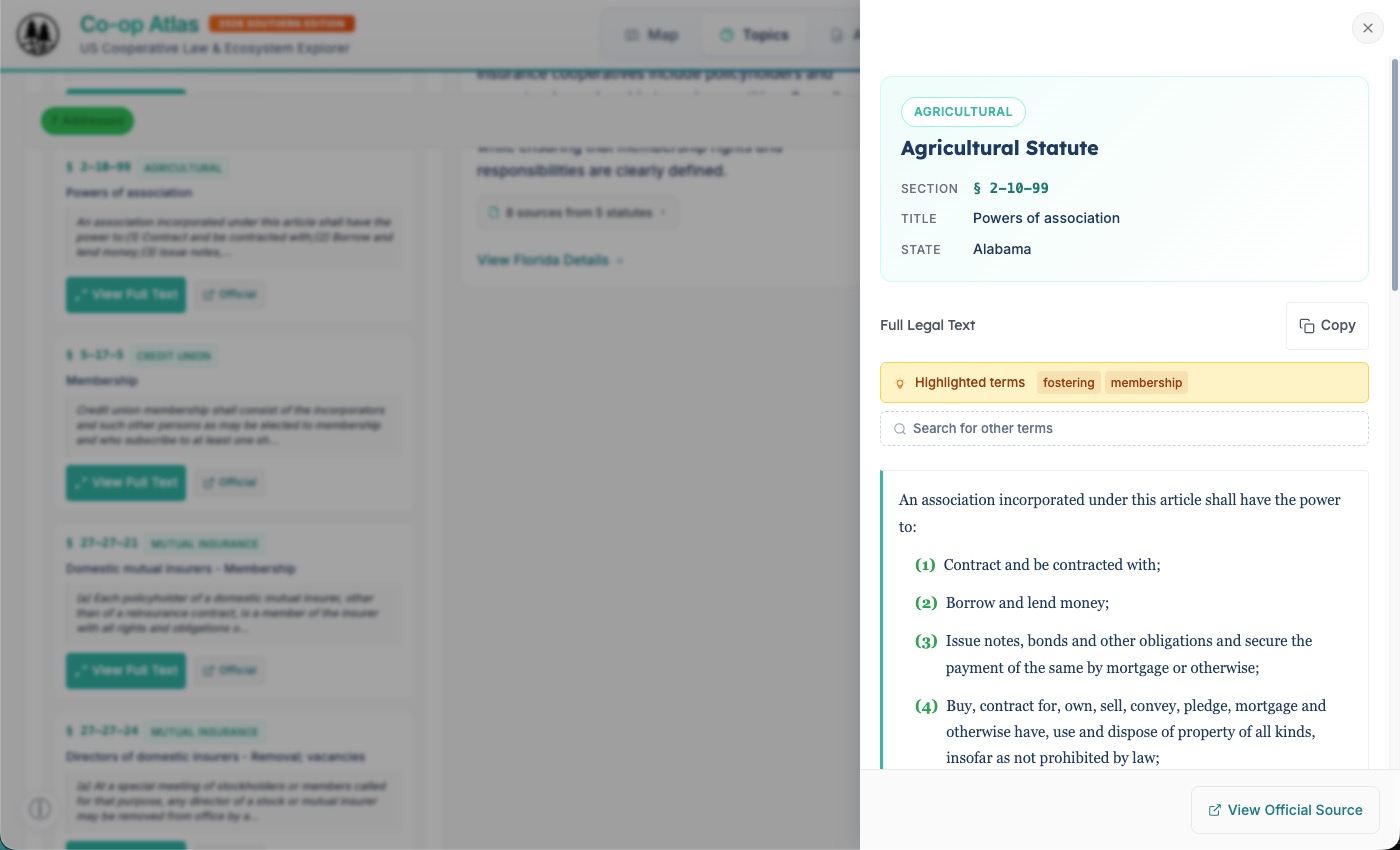
Answers remain tied to statutes, documents, and source references that can be reviewed and reused
Global Edition world map view showing cooperative law coverage by region.
Global Edition: international legal collection and discovery layer
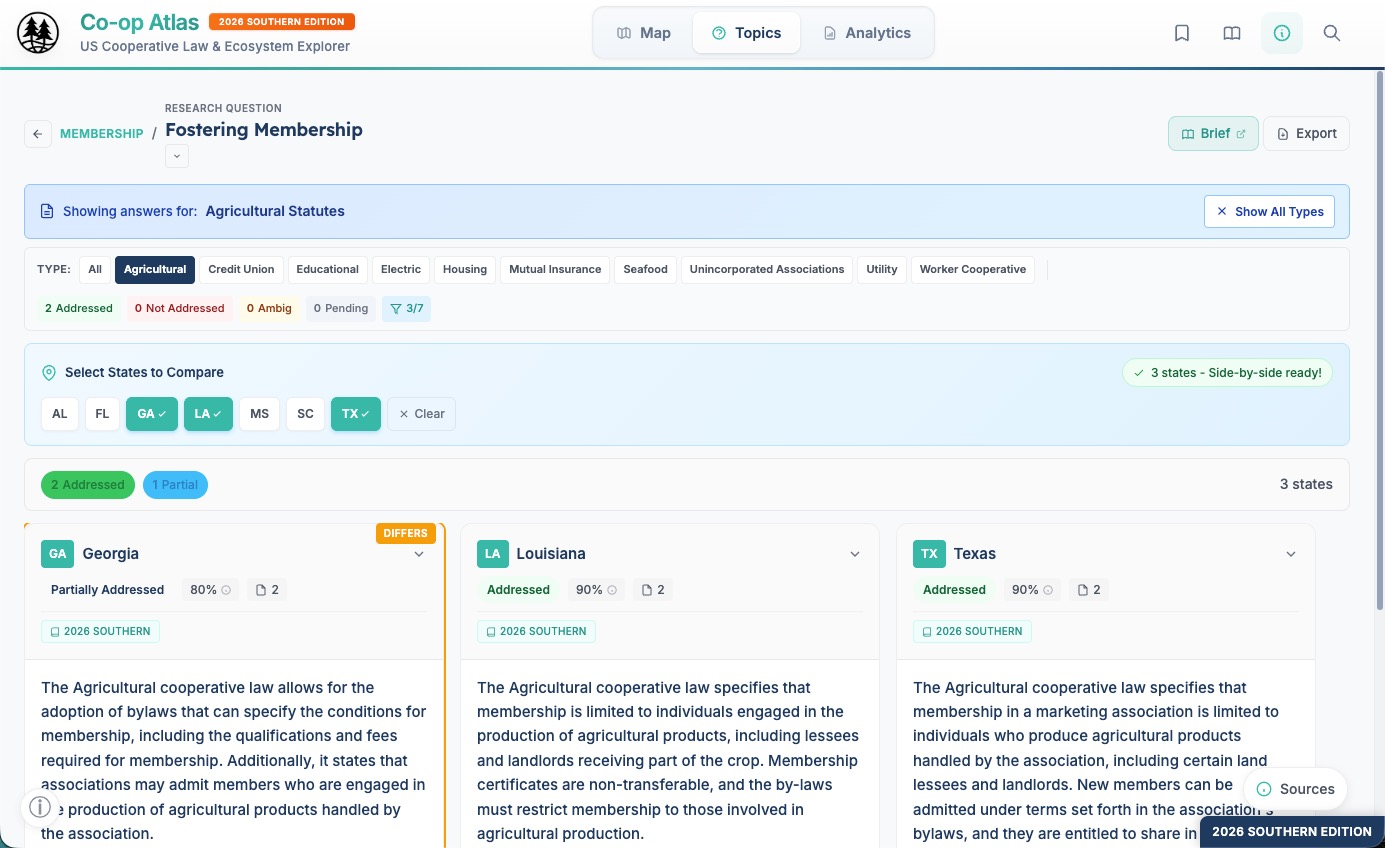
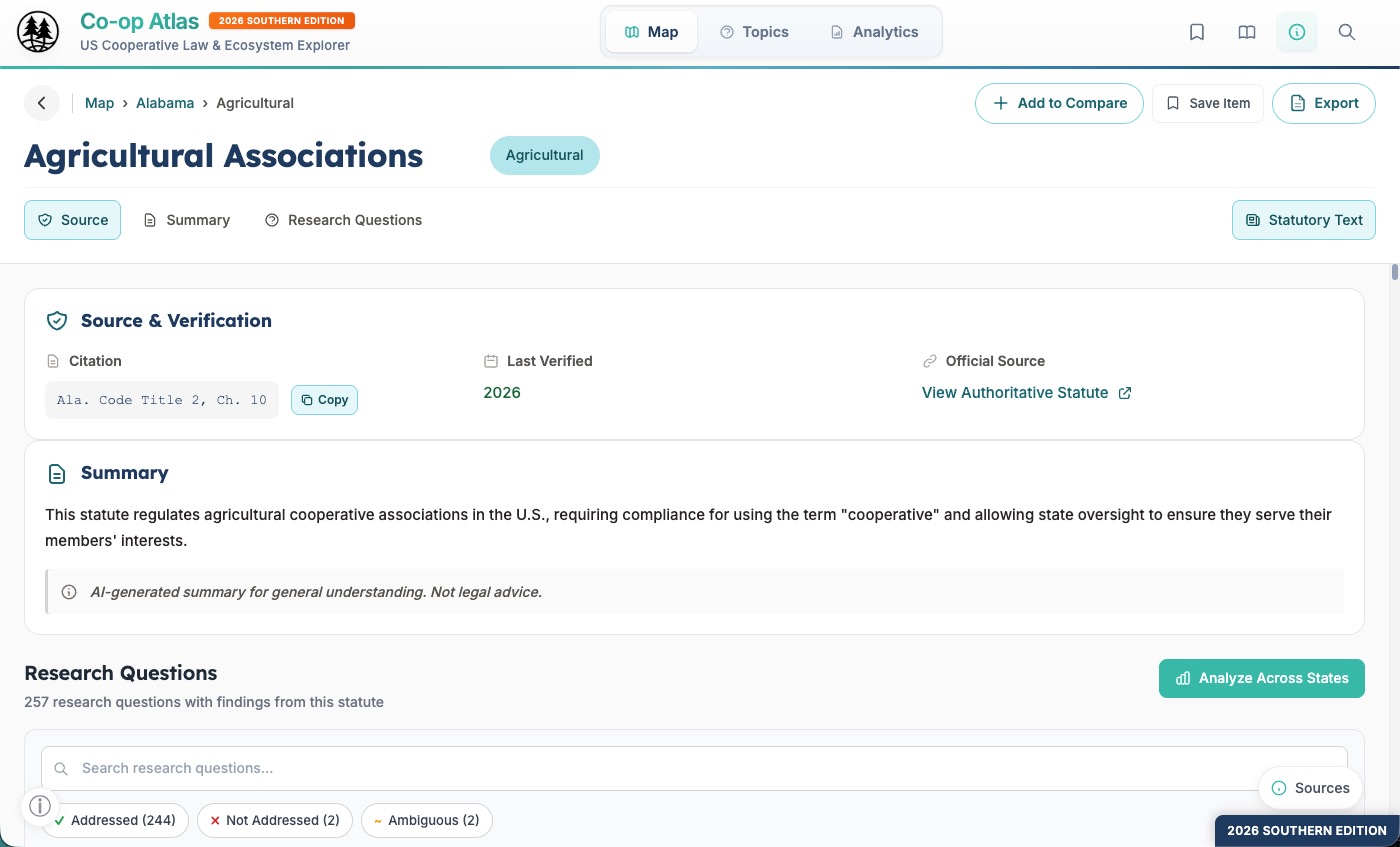
U.S. Southern Edition brief-style view summarizing a cooperative law question.
Southern Edition: question-based brief output

What you get

A reusable answer, not just a pile of legal documents.

Co-op Atlas is built to produce structured outputs that answer recurring legal questions across jurisdictions and keep the statutory basis visible.

Sample output

Quorum requirements for boards of directors.

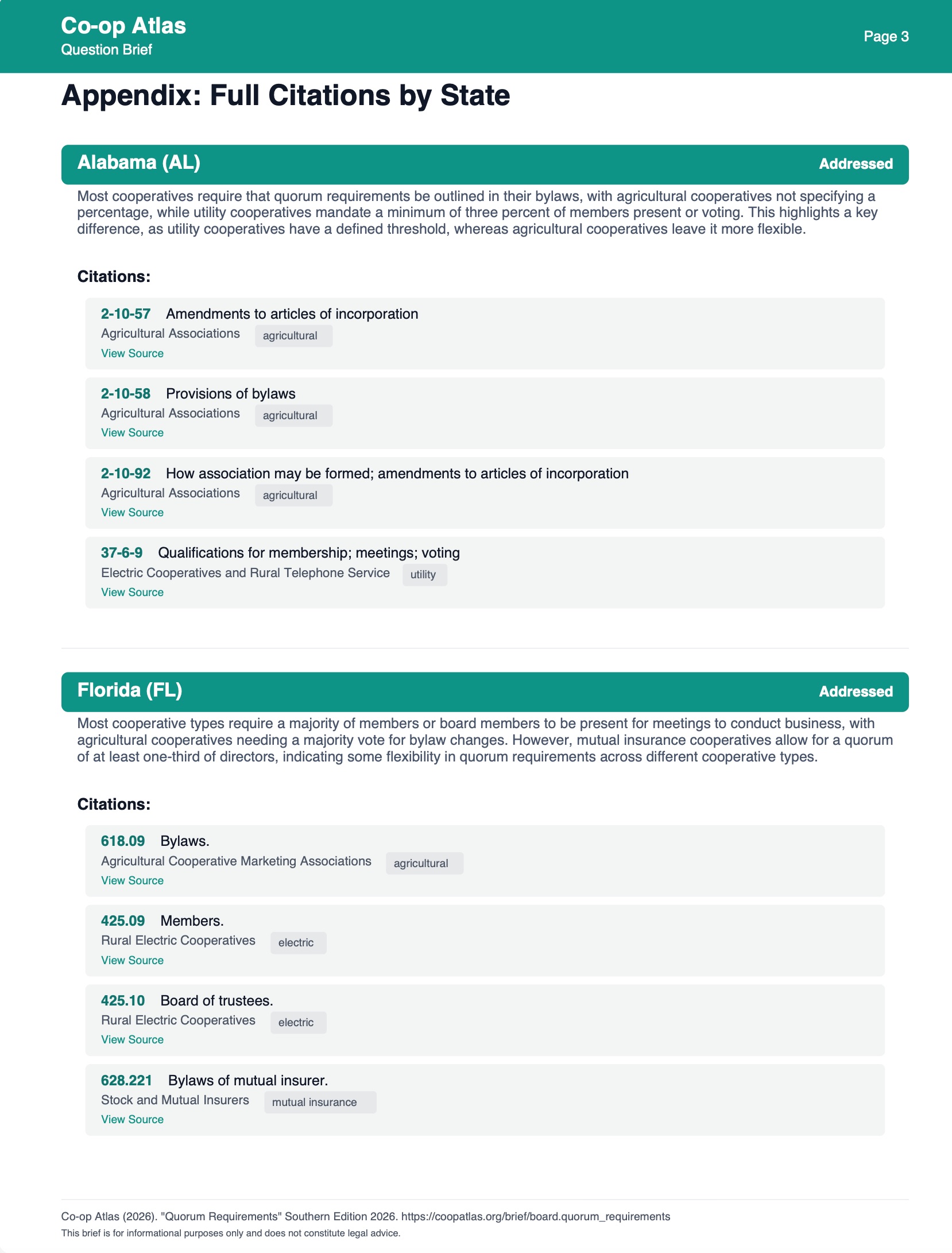
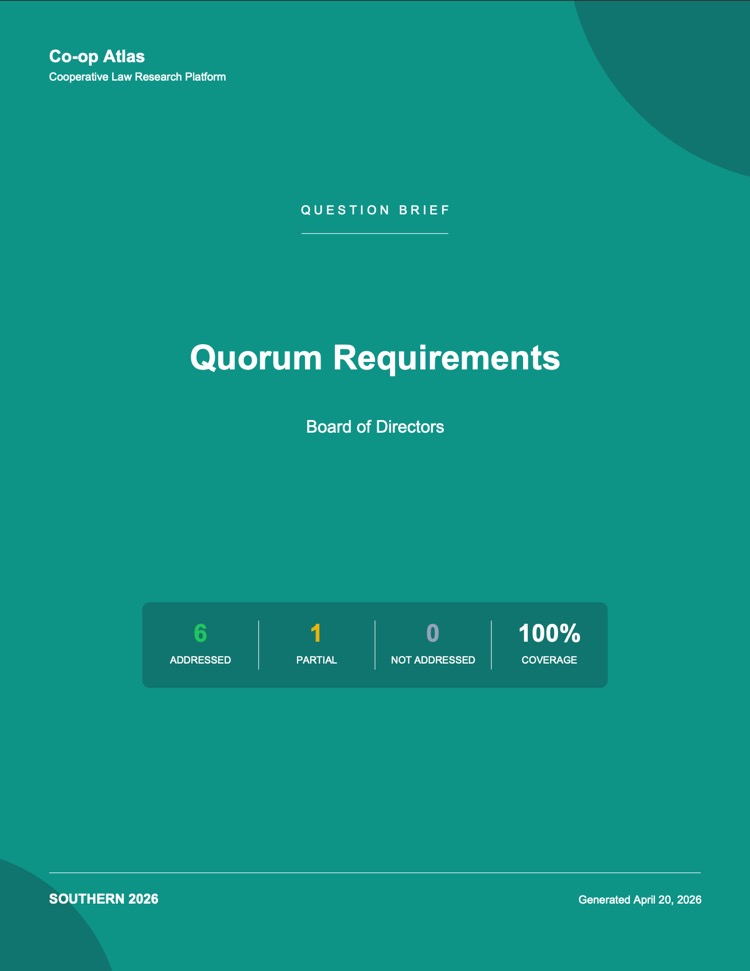
This sample is drawn from the actual Southern Edition question brief Quorum Requirements: Board of Directors, generated April 20, 2026. The brief covers seven Southern states, marks six as addressed and one as partially addressed, and turns the question into a reusable comparative answer.

  • Georgia: Most cooperative types can define quorum in their bylaws, while credit unions require a majority of directors and utility cooperatives require a majority of directors plus at least 10 percent of voting members for member meetings. Citations include 7-1-656 and 46-3-296.
  • Louisiana: Agricultural, seafood, and credit union statutes leave quorum more flexible through bylaws, while educational and electric cooperatives set a five percent member quorum unless adjusted. Citations include 17:2809 and 12:408.
  • Texas: Most cooperative types leave board quorum to the bylaws, while credit unions impose a more specific governance standard for bylaw or charter amendment actions. Citations include 251.053, 52.052, and 122.011.

The brief pairs a state findings summary with a full appendix of citations by state, so the answer can be reviewed, shared, and reused without losing the statutory basis.

Open the full quorum brief

What Co-op Atlas is

A system for recurring cooperative law questions.

Organizations regularly face the same kinds of legal questions about governance, membership, taxation, formation, and related cooperative law issues. Too often, the answer still depends on manual statute reading and one-off memos.

Co-op Atlas helps turn that work into a more structured process: legal data in, questions framed clearly, jurisdictions compared directly, and citation-grounded answers produced in formats that can be reused.

Frame the question

Start with the legal question an organization actually needs answered.

Compare jurisdictions

See how multiple places handle the same issue in one structured view.

Produce structured answers

Generate summaries, comparisons, and brief-style outputs that can circulate.

Reuse the result

Keep answers grounded in citations so they can be checked, updated, and reused.

  • Researchers and academic teams
  • Policy and advocacy organizations
  • Legal professionals and legal aid groups
  • Cooperative developers and support organizations
  • Institutional and international partners

How it works

From legal source material to citation-backed answers.

The system is simple by design: gather the law, frame the question, compare the jurisdictions, and produce an answer that can be checked and reused.

1. Legal data

Statutes, reports, and related legal documents are collected and organized.

2. Questions

Recurring legal questions are framed clearly so the comparison has a usable target.

3. Structured comparison

Jurisdictions are compared in a format that makes differences and common patterns visible.

4. Citation-backed answers

Outputs summarize the answer while keeping the cited legal basis close at hand.

Editions

Two editions under one initiative.

Co-op Atlas currently includes a Global Edition and a U.S. Southern Edition. They share a mission, but they play different roles within the broader effort to produce structured, reusable answers from cooperative law.

Global Edition

Broad international legal discovery across countries and documents.

The Global Edition is the broad discovery layer of the initiative. It brings together an international cooperative law collection and helps users locate, explore, and compare source material across jurisdictions.

Its role is to expand the legal collection and comparative reach that structured analysis can build on.

  • Built around a distinct global legal collection
  • Useful for international discovery, comparison, and legal terrain mapping
  • Supports search, map views, document exploration, and comparison setup
  • Feeds the broader goal of structured cross-jurisdiction answers
Explore Global Edition

U.S. Southern Edition

A working demonstration of structured legal intelligence.

The U.S. Southern Edition is more than a regional collection. It is a working example of how recurring cooperative law questions can become structured cross-jurisdiction answers, citation-grounded analysis, and reusable briefs.

Short visual overview of the Southern Edition

  • Built around a distinct seven-state legal collection
  • Organizes analysis around recurring legal questions rather than only document browsing
  • Produces structured comparisons, answer summaries, and brief-style outputs
  • Shows the working methodology behind citation-grounded comparative analysis
Explore U.S. Southern Edition

Why it matters

Recurring legal questions need better answers, not just better search.

Cooperative organizations, associations, and institutional partners often face the same legal questions repeatedly. When every answer depends on manual statute reading, the work is slower, harder to reuse, and more difficult to scale across teams.

Governance and operations

Questions about quorum, voting, membership, and board powers benefit from answers that are comparable across jurisdictions and ready to reuse.

Legal advising

Advisors need a faster way to move from question to answer while keeping the cited statutory basis visible and reviewable.

Policy analysis and reform

Comparative, question-based outputs make it easier to benchmark jurisdictions and support more grounded reform conversations.

Comparative research

Researchers benefit when recurring questions can be answered in a format that is structured, comparable, and grounded in source law.

Institutional memory

Structured answers help organizations preserve and reuse legal knowledge instead of recreating the same analysis from scratch.

Built for recurring legal work

Designed for teams that need consistent answers over time.

Co-op Atlas is designed for organizations that receive recurring legal questions and need a more repeatable way to answer them. The emphasis is not only on access to law, but on outputs that can circulate, support decisions, and be revisited later.

What the system produces

  • Question-based comparative outputs
  • Structured answer summaries
  • Citation-grounded legal analysis
  • Brief-style outputs that can be shared and reused

Who this work serves

  • Cooperative associations and development organizations
  • Legal and policy teams
  • Research institutions and libraries
  • Public-interest infrastructure partners and international bodies
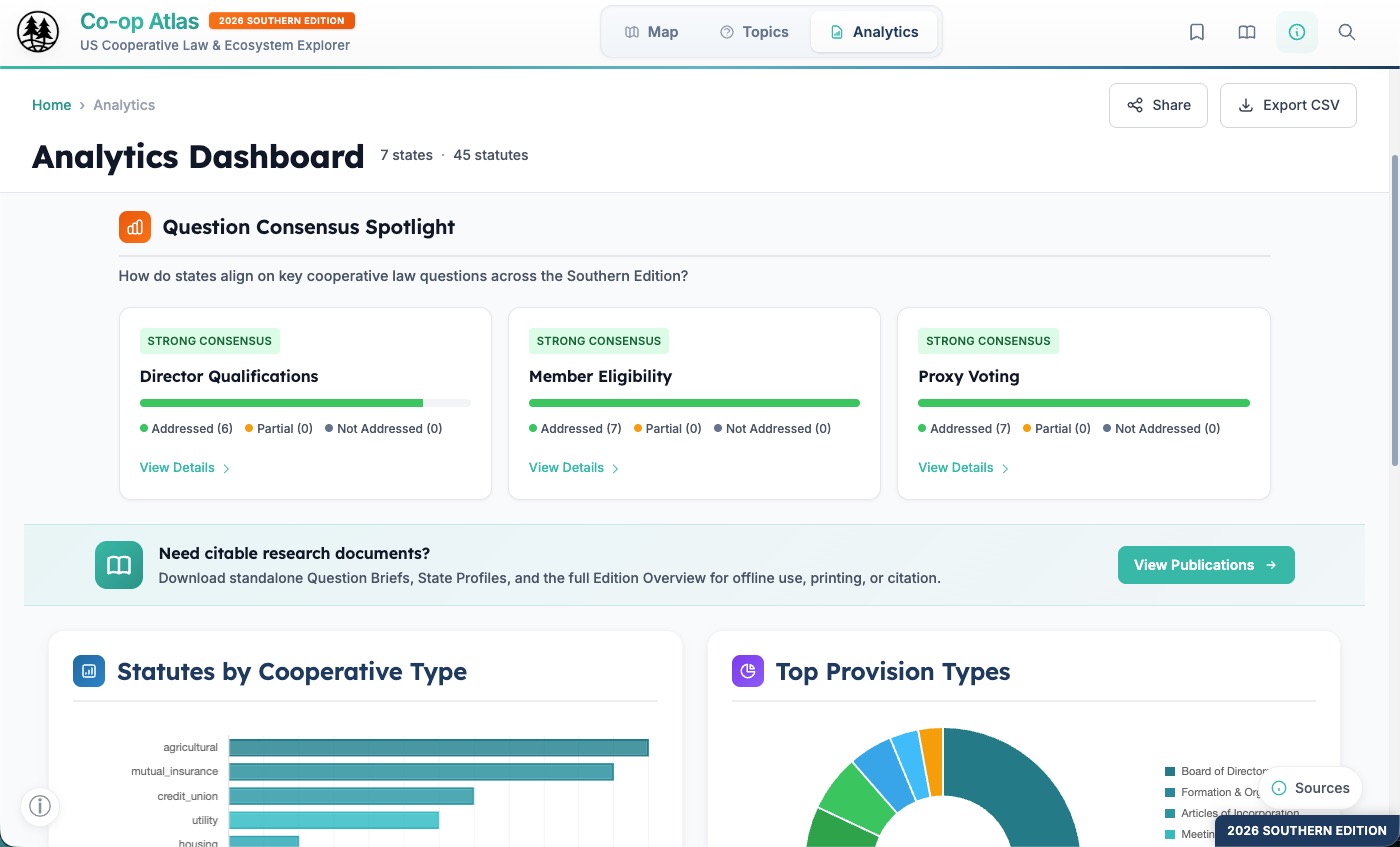
U.S. Southern Edition publication overview page with release and coverage information.
Publication-style outputs for reusable legal analysis
Global Edition regional analysis view comparing cooperative law patterns across world regions.
International legal collections that support broader comparative work

Explore the work

See the collections and the working outputs.

Explore the Global Edition for international legal discovery, or review the U.S. Southern Edition to see how cooperative law questions can become structured, citation-grounded comparative answers.